


The U.S.-Iran "Islamabad Memorandum of Understanding," explained

Updated: Jun 21

The signature page of the Islamabad Memorandum of Understanding, signed 17 June 2026
On 14 June in Washington (15 June in Tehran), the United States and Iran reached an agreement on the “Islamabad Memorandum of Understanding.” This is a deal whereby the two sides promise to extend their ceasefire for another 60 days while moving onto deeper negotiations over a permanent settlement of the conflict and Iran’s nuclear program. It comes after weeks of “will they, won’t they” negotiations in which both the White House and Tehran threatened escalation and a return to hostilities if their individual demands were not met.
In theory, the peace memorandum will satisfy the immediate interests of the two sides, but in practice, many obstacles still remain, particularly given the relatively short time period and the ongoing presence of potential spoilers to the peace process. The clock is now ticking on a 60-day deadline for U.S. and Iranian negotiators to reopen the Strait of Hormuz, release funds and assets to Iran, and to come to terms on nuclear issues, all while determining what to do about the enduring conflict in Lebanon. This is a precarious peace process, now held together by a non-binding memorandum and whatever political will may exist in the White House and Tehran.
Understanding the future trajectory of the U.S.-Israel-Iran war requires a breakdown of the peace memorandum, its potential utility, and the way ahead for implementation. To do that, it is necessary to examine how the parties reached this point, the content of the agreement itself, and the next steps in the peace process.
Background on the negotiation
A few weeks ago, U.S. President Donald Trump was almost at a point where he might have declared military victory and disengaged unilaterally from the conflict. However, there were two issues: (1) Israel’s expansion of the war into Lebanon; and (2) unresolved Iranian interests. Israel’s continued hostilities in the region introduced both commitment problems in the peace process as well as an additional layer of negotiations. Meanwhile, the unresolved Iranian interests included issues such as war reparations and firm security guarantees.
Meanwhile, Iran relied on its principal source of leverage: coercion in the Strait of Hormuz. Iranian forces mined the strait and attacked vessels which attempted to transit the waterway, including Thai and South Korean commercial transports. This action disrupted the international economy, affecting oil prices and global markets alike.

The damaged hull of a South Korean tanker damaged by an alleged Iranian missile strike, May 2026 (photo via Republic of Korea Ministry of Foreign Affairs)
The White House responded to Iran’s attempts to control the Strait of Hormuz with a naval blockade, which contributed to the impasse in the conflict. The coercion hardened the Iranian position against potential capitulation, with Tehran asserting that it would not bend to U.S. demands.
With military action proving unsuccessful in reopening the Strait, the U.S. turned to negotiations as a means to resolve outstanding issues vis-a-vis the conflict. Since the outset of Operation Epic Fury, the White House had articulated several objectives. These included the following:
Regime change
Destruction of Iran’s missile capabilities
Elimination of Iran’s navy
Ensuring Iran never obtains a nuclear weapon
Disabling Iranian support to hostile proxies
Guaranteeing free and open transit through the Strait of Hormuz
The United States was successful in substantially degrading Iran’s military capabilities while also decimating the country’s defense industrial base.
On the Iran side, Tehran had been consistent in its declared interests:
Complete cessation of hostilities (including in Lebanon)
Recognition of Iran’s sovereignty (namely, regime survival and the inherent right to nuclear enrichment)
Formal, international ceasefire guarantees
War reparations
Closure of U.S. bases in the region
Lifting of the U.S. blockade
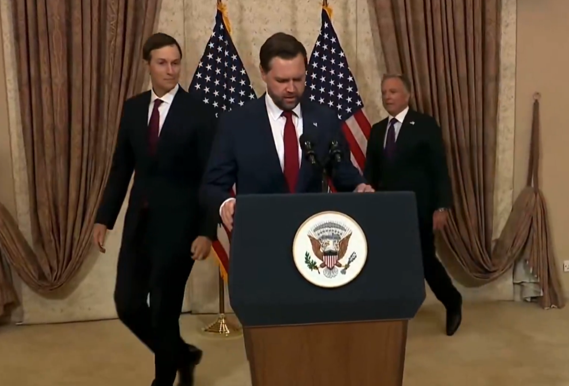
Vice President JD Vance, with Jared Kushner and Steve Witkoff in the background, addresses the media after the Islamabad Talks failed to produce a negotiated agreement, 12 April 2026 (screen capture via X/Twitter @WhiteHouse)
Such were the conditions for the negotiation and the interests at play, and after weeks of deliberation via intermediaries (principally from Pakistan and Qatar), the White House and Tehran agreed on a memorandum of understanding. This first came via electronic signatures on 14/15 June, with the two sides signaling that there would be a formal signing ceremony with Vice President JD Vance and Iranian Parliamentary Speaker Mohammad-Bagher Ghalibaf on 19 June in Switzerland.
However, the two sides accelerated the timeline, with President Trump, Iranian President Masoud Pezeshkian and Pakistani Prime Minister Shehbaz Sharif physically signing the document in Versailles, Tehran, and Islamabad, respectively, on 17 June. Three factors contributed to this acceleration: (1) Tehran insisted on head of government-level signatures; (2) the White House was facing domestic pressure to release the text of the memorandum but Tehran and mediating countries did not want to release it prematurely; and (3) implementation would not begin in earnest until the two sides had final signatures on the memorandum.

President Trump signs the Islamabad Memorandum of Understanding in Versailles, 17 June 2026 (photo via X/Twitter @WhiteHouse)
Breaking down the peace memorandum
The agreement is composed of fourteen articles spanning just a few pages. Given the relatively short length of the memorandum, it is reasonable to go through each of the provisions here to gain a more thorough understanding of its terms and conditions. The breakdown is as follows:
Type of agreement: Memorandum of Understanding (MOU)
A memorandum of understanding is a commonly used international instrument that is not legally binding but establishes pledges and expectations for conduct going forward. Here, it serves as a framework agreement that establishes the conditions for an extended ceasefire with a promise for continued diplomatic negotiations.
Paragraph 1: Ceasefire pledge
This paragraph provides for a complete ceasefire that extends to Lebanon. Problematically, the memorandum mentions that this applies to the two sides’ “allies” (i.e., Israel and Iran’s hostile proxies such as Hezbollah), despite these allies not being signatories to the agreement. The Israeli government has already said it is not a party to the memorandum, and Israel Defense Forces have continued operations in Southern Lebanon this week. Meanwhile, Hezbollah has continued its attacks in northern Israel.
Notably, this paragraph refers to the conflict between the United States and Iran as the “current war,” which refutes the U.S. administration’s own domestic claims that this conflict does not constitute a war.

Graphic depicting areas of Israeli-occupied areas of southern Lebanon (photo via X/Twitter @IDF)
Paragraph 2: Respect for sovereignty
This provision is a common pledge in peace agreements which states that the two sides will respect each other’s sovereignty.
Paragraph 3: Deadline
This paragraph establishes a 60-day deadline for reaching a full and final agreement to the war, but it provides for the parties extending the deadline upon mutual consent. Making the deadline extendable gives flexibility but also introduces the risk of the parties treating it as arbitrary and subject to political whims.
Paragraph 4: Lifting the naval blockade
Here, the United States commits to begin lifting its blockade against Iran upon signing of the memorandum. This provision is not specifically tied to any reciprocal Iranian actions.
Paragraph 5: Reopening the Strait of Hormuz
This provision calls for the immediate reopening of the Strait of Hormuz. Following the reopening, Iran will make arrangements for safe, toll-free passage for 60 days. This includes demining the strait within 30 days, a responsibility assigned solely to Iran without allowances for multinational participation.
After the 60-day period, the agreement leaves it in the hands of Iran and Oman to determine appropriate measures for charging fees across the strait. Tehran had previously signaled its intent to toll vessels for transiting the strait, shifting its verbiage to charging fees for things such as navigational aid and environmental management to avoid international scrutiny.

The Karaj B1 bridge after U.S. airstrikes, 3 April 2026 (photo via X/Twitter @araghchi)
Paragraph 6: Reconstruction fund
This paragraph calls for the delivery of at least $300 billion to Iran for the purposes of reconstruction. Tehran has called for war reparations, and this fund partially satisfies this demand. The agreement mandates the creation of a mechanism within 60 days for delivery of these funds, introducing risk that Tehran could hold nuclear negotiations hostage to fulfillment of this provision.
Paragraph 7: Sanctions relief
Here, the MOU establishes that the United States will terminate “all types” of sanctions including those imposed via UN Security Council resolutions. Importantly, this provision does not specify nuclear-related sanctions, leaving an open question about sanctions related to other illicit activity.
Paragraph 8: Commitment to denuclearize
In this provision, Tehran “reaffirms” its commitment to denuclearize, which is deliberate word choice to imply that this is not a new commitment. Ultimately, this paragraph defers any real concessions related to Iran’s nuclear programs to a future agreement.
Paragraph 9: Maintenance of status quo
This paragraph mandates that Iran will maintain the status quo for its nuclear program and the United States will not add new sanctions or increase its military posture in the region during the follow-on negotiation period. Importantly, there are no verification mechanisms for this provision, meaning that it will be easy for Iran to dispute U.S. implementation and difficult for U.S. to confirm whether Iran is upholding its obligations.
Paragraph 10: Sanctions waivers
This provision mandates immediate sanctions waivers for Iranian oil trade. This will allow for immediate flow of money back to Iran.
Paragraph 11: Releasing frozen assets
This paragraph calls for release of Iranian assets in line with implementation of the MOU.
Paragraph 12: Creation of implementation mechanism
Here, the MOU calls for the establishment of an “executive mechanism” for monitoring implementation of the agreement. However, the memorandum does not provide details on the composition or functions of this mechanism, and it does not call for third party oversight.
Paragraph 13: Sequencing
This provision mandates that initiation of MOU implementation is tied to establishment of a ceasefire, lifting of the blockade, reopening of the Strait of Hormuz, sanctions waivers, and the unfreezing of Iranian assets. It dictates that nuclear negotiations will not commence until these actions have begun. In other words, disputes over this paragraph alone could prevent the parties from ever reaching negotiations on the agreement’s most consequential issues.
Paragraph 14: UN Security Council endorsement
This provision calls for UN Security Council endorsement not of the peace memorandum, but of the final agreement between United States and Iran.
The signed Islamabad Memorandum of Understanding
An uncertain path ahead
Implementation of the MOU remains tenuous, with both sides threatening to return to hostilities if the provisions go unfulfilled. During his remarks in France on the sidelines of the G7 summit, Trump said of the MOU: “It’s not final. It’s a memorandum of understanding. And if I don’t like it, we’ll go back to shooting at them, dropping bombs on their head.”
Meanwhile, Iran’s Supreme National Security Council published a statement noting, “With complete distrust toward an unreliable adversary, and under strict monitoring of both the negotiation process and implementation of commitments, any breach by the U.S. will trigger a reciprocal response in accordance with a pre-established plan.”
Implementation was set to commence on 18 June, the day after the signing of the MOU, with officials from the United States, Iran, Pakistan, and Qatar set to hold their first round of meetings in Bürgenstock, Switzerland on the 19th. However, the Swiss Foreign Ministry published a last minute announcement that those talks had been postponed.
None of the parties have formally commented on the postponement of talks, but Tehran is reportedly seeking progress on the MOU’s implementation prior to proceeding with subsequent negotiations, as provided for in the memorandum. As indicated earlier, paragraph 13 calls for the implementation of certain other provisions related to the ceasefire, naval blockade, Strait of Hormuz, and delivery of funds to Iran. So, here are where things stand on these issues:
Ceasefire: Fighting between Israel and Hezbollah in southern Lebanon and northern Israel has continued despite the signing of the MOU. The Netanyahu administration has asserted that it is not a party to the agreement, carrying out additional strikes following the memorandum coming into effect.
While fighting complicates the peace process, the Israeli government’s position that it will not withdraw from “security zones” may be an insurmountable obstacle to it. Tehran has made clear its expectations that there could be no final agreement until Israel has withdrawn from occupied areas of Lebanon—areas which the Netanyahu administration refers to as “security zones.” However, in an address delivering his administration’s position towards the memorandum, Netanyahu stated, “We will remain in the security zones for as long as it is required to defend our country.”
Naval blockade: On 18 June, U.S. Central Command announced the lifting of the naval blockade. While there is no direct tie-in within the MOU between the lifting of the blockade and the reopening of the Strait of Hormuz, the White House may seek to link the two during the implementation phase if there are complications with maritime transit.

U.S. Central Command’s announcement regarding lifting the naval blockade (screen capture via X/Twitter @CENTCOM)
Strait of Hormuz: Transit through the Strait of Hormuz has incrementally increased, with countries such as Japan reporting successful movement of previously stranded vessels. However, there are lingering questions regarding enduring maritime safety as the White House and Tehran wrestle with the MOU’s other provisions and lack of clarity in the mechanics of the strait’s reopening.
Funds to Iran: There have been no reports related to U.S.-led sanctions relief or unfreezing of Iranian assets. Meanwhile, French officials have stated that there will not be any lifting of UN Security Council-mandated sanctions without France’s approval. As a permanent member of the Security Council, France holds veto power over any potential resolutions that could lift sanctions, meaning that there is an additional layer of negotiations between the United States and the other council members to actualize this provision of the memorandum.
* * * * *
While the signing of the memorandum offers a brief respite from continued escalation in the conflict, it will take additional effort from the White House and Tehran to transform conditions into a durable peace process. There are deep structural issues in the MOU’s design that affect its implementability, and Israel and Iran’s hostile proxies continue to represent wildcards that could collapse the unstable foundations for peace. The key for the parties will be restraining their respective allies and satisfying the commitments outlined in paragraph 13 in order to advance the implementation process. If these steps cannot be achieved, then the parties may never reach the substantive negotiations on Iran’s nuclear program and a final settlement to the war that the memorandum was intended to facilitate.
Michael MacArthur Bosack is a seasoned international negotiator and the founder of the Parley Policy Institute. He is the Special Adviser for Government Relations at the Yokosuka Council on Asia-Pacific Studies. Previously, Michael served as the Deputy Secretary of the United Nations Command Military Armistice Commission in Korea and the Deputy Chief of Government Relations at Headquarters, U.S. Forces, Japan. He is a former East-West Center Fellow, a military veteran, and the author of “Negotiate: A Primer for Practitioners.”
Cable No. 64:
Full text of the Islamabad Memorandum of Understanding:


