


Breaking down the start of U.S.-Iran war termination negotiations


Roughly twelve hours before his self-imposed deadline for opening the Strait of Hormuz, President Donald Trump announced that U.S. and Iranian officials had “productive conversations regarding a complete and total resolution of our hostilities in the Middle East.” He noted that the two sides will continue their discussions this week, during which time he would postpone threatened strikes against Iranian energy infrastructure. It marks the first de-escalation and acknowledgment of diplomatic contacts since the outbreak of hostilities nearly a month ago.
This is not to say that a ceasefire is imminent—after all, some Iranian officials have flatly denied that the talks are happening at all. It also does not mean de-escalation of conflict, as they may seek to push the boundaries of what is achievable through military action. What it does mean is that Washington and Tehran have realized that the opposing side’s outright capitulation may not be a viable outcome, so other options are necessary to explore.
With political, military, and economic costs mounting, both the United States and Iran may consider a near-term cessation of hostilities preferable to a drawn-out effort to eke out further concessions. However, given the gap between their respective conditions for ending the war, a negotiated peace agreement may still not be immediately achievable under current circumstances. As such, facilitating a ceasefire will likely require third parties to foster conditions for an agreement between the belligerents, or at least willful disengagement from their respective war efforts.
Understanding the pre-negotiation phase
There are six phases of negotiation, the first of which is pre-negotiation. This is the phase where parties determine whether it is in their interest to pursue formal negotiations. They look at their interests, constraints, and restraints and consider what the other side's negotiating objectives may be. To do this, they may employ back channel contacts, engagement through intermediaries, signaling in the media, or other forms of interpretation and analysis.
If there is a zone of possible agreement for a deal that would be within their interests, they may seek to move into the next phase of negotiations, which is the “agreement to negotiate” phase. This is where the parties determine how the formal negotiations should proceed. They answer questions such as: who will be conducting the negotiations; where will the deliberations take place; will there be intermediaries; and what are the parameters of the negotiations?
If they can successfully answer these questions, then they move to the formal negotiation phase.
Last week, Washington and Tehran entered the pre-negotiation phase, and with Trump’s revelation that Special Envoy Steve Witkoff and Jared Kushner had engaged Iranian counterparts through Egyptian and Turkish intermediaries on 22 and 23 March, they may now be deliberating the parameters of formal ceasefire negotiations. The specifics of their discussions are yet to be revealed, but it is evident that the United States and Iran have initiated the negotiating cycle for war termination. How far they proceed in it is a different matter.

The six phases of negotiation, from Negotiate: A Primer for Practitioners (2022)
Feeling the costs of war
A logical question is why the seemingly recalcitrant parties might now be willing to engage in ceasefire negotiations. After more than three weeks of hostilities, costs have mounted for all parties to conflict, as well as for regional neighbors.
For the United States, the costs are far-reaching. The military is expending interceptors and munitions at unsustainable rates, forcing backfills from other regions. It has increased strain on allies who have become the target for U.S. President Donald Trump’s ire for not immediately throwing diplomatic and military support behind the American war effort. Gas prices have risen across the United States, forcing the White House to pursue emergency efforts to stabilize markets, including relaxing sanctions on both Russia and Iran. Further, the war has created fissures in the White House's Republican base, which supported the president for his “America First” platform and policy of “no new wars.” With thirteen U.S. service members killed in action, the impacts on global markets affecting households, and midterm elections looming later this year, military, economic, and political costs will continue to mount the longer this war proceeds.
Meanwhile, the government in Tehran has suffered heavy losses over the past month of fighting. The Iranian government has lost echelons of top leadership, with current cadre remaining at risk of further decapitation strikes. Iran's conventional military capabilities have been severely degraded, as well as its nuclear development facilities. The economic impacts of the war have not been widely reported, but they would invariably be high given the level of disruption to Iran’s oil exports.
As for Israel, the Netanyahu government faces similar problems as the United States militarily. The Israel Defense Force is expending its stockpiles of interceptors and munitions and will be competing with its main security partner in the U.S. for backfills. Further, Israel faces increased diplomatic backlash amid the unilateral expansion of its war effort into Lebanon.

U.S. forces launch a Patriot interceptor on an undisclosed date during the war (screen capture from a U.S. Central Command video published 11 March 2026)
The pre-negotiation signals
Prior to the revelations that discussions between the United States and Iran had begun, both sides had signaled a willingness to consider an end to hostilities. President Donald Trump has said that the United States is winding down the war effort. Iranian officials like Supreme Leader Mojtaba Khamenei and President Masoud Pezeshkian have clearly messaged what Tehran’s conditions for a ceasefire would be. The holdout remains Israel, where the Benjamin Netanyahu administration continues to push the boundaries of military hostilities.
Iranian leaders have publicly mentioned four conditions for ending the war:
Recognition of Iran's sovereignty (namely, regime survival and the inherent right to nuclear enrichment)
Formal, international ceasefire guarantees
War reparations
Closure of U.S. bases in the region
Meanwhile, the U.S. government has shown malleability in its wartime objectives, which allows for greater flexibility in the pre-negotiation phase. On 2 March, the White House listed four objectives, while President Trump altered those to six in his 20 March Truth Social post. These are included in the graphics below:

The day after Trump’s post noting that the United States was meeting its objectives, Axios reported that U.S. officials were floating the following six terms for a ceasefire:
No Iranian missile development for five years
No uranium enrichment
Decommissioning of the Fordow, Ishafan, and Natanz nuclear reactors
Third party observation of development of centrifuges and related machinery that could advance a nuclear weapons program
Negotiation and conclusion of arms control treaties with regional neighbors that include restrictions on Iranian missiles (no more than 1000)
Zero financing to hostile proxies (e.g., Hezbollah, the Houthis, or Hamas)
As for the Netanyahu administration, the Israeli government has not moved away from its goal of regime change in Tehran, and it has demonstrated a willingness to play the role of spoiler to support that objective. A salient example of this was the Israeli strike on the South Pars gas field, which Trump claimed happened without U.S. knowledge or consent.
The potential role for third parties
At this point, Washington and Tehran will be working to determine whether a ceasefire agreement is achievable. However, the opening positions that both sides have signaled would be tantamount to a de facto surrender from the other. While concessions are possible, there are political costs for accepting anything short of maximalist demands for both the White House and the Khamenei regime.
There is, however, space for third parties to foster conditions for a ceasefire agreement or disengagement. In essence, third parties must take stock of the respective interests and positions that have already been signaled and see where they can step in to satisfy them. For example:
Third party countries can conduct shuttle diplomacy to eliminate potential political costs of sitting down face-to-face during ongoing hostilities.
The IAEA can engage Tehran directly on a new agreement related to inspection and monitoring of its nuclear programs.
America’s partners can create a “peace coalition” that puts its forces in the region to create a de facto buffer between U.S. and Iranian forces.
Middle Eastern governments can enter into their own individual negotiations with Tehran related to establishing conditions for peacebuilding going forward.
The international community may look at relaxing sanctions on Iran as an alternative to “war reparations.” The White House has already lifted some sanctions to stabilize global oil markets, and this could be the method they pursue as a compromise.
If third parties can set the right conditions, there may not even need to be a U.S.-Iran ceasefire agreement to achieve an end to hostilities. Rather, both sides may just be able to declare that they have met their objectives and disengage from their respective war efforts.
Obstacles to military disengagement
While it may be possible to set the conditions for a ceasefire agreement or disengagement from military hostilities, there are four notable obstacles.
The first is Israel's ambitions for regime change. The Netanyahu administration views the current conflict as a once-in-a-lifetime opportunity for regime change. The U.S. will need to restrain Israel because it is able to play the role of spoiler in the peace process.
Second, there is a risk of continued violence from hostile proxies. Hamas, Hezbollah, and the Houthis may be backed by Iran, but they can operate independently of Tehran. They are also able to spoil the peace process.
The third is a myopic focus on positions rather than interests. If either side gets stuck on any individual positions (e.g., “zero nuclear enrichment” or “war reparations”), they may eliminate any space for de-escalation.
Finally, there is a risk of mishandling by the U.S. negotiating team. This is not a straightforward transactional negotiation. Achieving U.S. interests in interstate war termination will take diplomatic finesse and agile approaches that Special Envoy Steve Witkoff and Jared Kushner have not yet demonstrated in their intergovernmental negotiations on behalf of the White House. They will need to have learned from the mistakes in their previous rounds of nuclear negotiations and remain in lockstep with the U.S. interagency to maximize outcomes here.
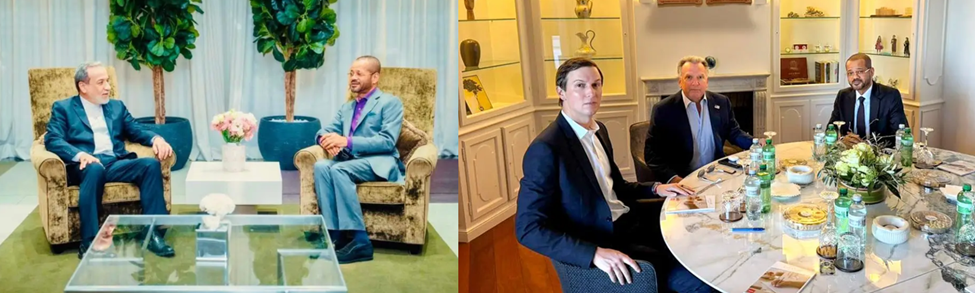
(Left) Foreign Minister Badr Albusaidi meets Iranian Foreign Minister Abbas Araghchi, 25 February 2026; (Right) Albusaidi meets U.S. Special Envoy Steve Witkoff and Jared Kushner, 26 February 2026 (photos via the Ministry of Foreign Affairs of Oman)
The way ahead
The next week will be critical in determining how far Washington and Tehran are able to proceed in the negotiating cycle. The initial phases of negotiation are tenuous at the best of times, and in this case, the United States has not fully committed to negotiations and Iran has denied any involvement in them. It remains possible that whatever talks may be happening fail to yield anything more than a brief reprieve from escalating strikes on energy infrastructure.
There will be several things to watch going forward:
Further announcements from the White House related to negotiations
Whether Iran formally acknowledges discussions with the United States and, if so, how Tehran characterizes any engagements
If hostile proxies step up attacks against Israel, U.S. forces, or other players in the region
Actions by third parties to facilitate dialogue and foster conditions for military disengagement
Ultimately, the emergence of tentative pre-negotiation dynamics underscores a fundamental shift: the parties to conflict are beginning to recognize the limits of military coercion in achieving their maximalist aims. Whether these early contacts evolve into formal ceasefire negotiations or collapse under the weight of competing objectives will depend on the ability of Washington and Tehran to recalibrate their expectations toward attainable outcomes. Importantly, a formal ceasefire agreement may not be what is necessary to achieve war termination if third parties can facilitate disengagement by the two sides. This is an inflection point in the U.S.-Israel-Iran War, and its trajectory now hinges on whether diplomacy can outpace the next escalation.
Michael MacArthur Bosack is a seasoned international negotiator and the founder of the Parley Policy Initiative. He is the Special Adviser for Government Relations at the Yokosuka Council on Asia-Pacific Studies. Previously, Michael served as the Deputy Secretary of the United Nations Command Military Armistice Commission in Korea and the Deputy Chief of Government Relations at Headquarters, U.S. Forces, Japan. He is a former East-West Center Fellow, a military veteran, and the author of “Negotiate: A Primer for Practitioners.”


