


Pakistan’s role in bridging Washington and Tehran


Pakistan hosted negotiations between the United States and Iran (dubbed the "Islamabad Talks") from 11-12 April 2026 (photo via X/Twitter @shen_shiwei)
On 28 February 2026, joint U.S.-Israeli strikes on Iran killed scores of senior officials and triggered a conflict that would disrupt roughly one-fifth of global oil supplies while ushering in major changes to the status quo in the Middle East. Qatar and Oman, the Gulf’s traditional interlocutors, were themselves directly impacted when Iranian forces struck U.S.-linked targets in their respective territories. Within a month, a different third party had become the war’s key channel for contact: Pakistan, a state with no recent record of great-power mediation, no foreign military bases on its own soil, and, until recently, a fraught relationship with Washington. By 17 June, that channel had facilitated the Islamabad Memorandum of Understanding (MOU), bringing an end to the U.S.-Israel-Iran War’s first phase.
After the MOU broke down amid mutual claims of non-compliance, Pakistan is again reprising its mediation role. As it does, there is utility in examining Pakistan’s function during the first phase of the conflict: why Washington and Tehran accepted Pakistan as an intermediary, how Islamabad assessed the two sides’ interests and negotiating limits, what it actually did to move them, how it worked alongside Qatar and Egypt in the effort, and what obstacles they encountered.
War breaks out, and Pakistan steps in
The effects of the U.S.-Israel-Iran War extended far beyond the region, reaching a Pakistani government that was already looking for peace on its own doorstep. The conditions were therefore ripe both for Pakistan to see a direct mediation role as serving its interests and for Washington and Tehran to accept Islamabad as an intermediary.
Islamabad depends heavily on the Gulf for its energy imports, giving it a direct economic stake in ending a war that had already disrupted global markets. It also had a different security calculus than other potential intermediaries. Pakistan was already conducting operations against militant groups operating from Afghanistan along its western border in recent years and had fought a brief conflict with India in the east only months earlier in May 2025. Of its major neighbors, only its border with China remained calm. A prolonged war in Iran—another neighbor—threatened to open a third front of instability at a moment Pakistan could least afford one, giving Islamabad impetus for bringing the fighting to a close. There was a reputational dimension, too: Pakistan’s rapprochement with the second Trump administration after the 2025 conflict with India gave Islamabad a fresh channel to Washington it had reason to reinforce.
From Washington and Tehran’s perspective, Pakistan offered a uniquely useful combination of qualities. The absence of foreign military bases meant that there was nothing that either belligerent could potentially treat as a target and Islamabad could avoid the same level of entanglement in the war as others like Doha. Pakistan also shares a long border and religious connection with Iran, home to a large Shia population of its own, giving it standing in Tehran that Sunni Arab states structurally lacked. Further, Pakistan offered a distinctive combination of an established security relationship with Washington and working military and security contacts with Tehran. Its standing in Washington had also improved after its brief 2025 conflict with India, when Pakistani restraint earned the government consideration as a net regional stabilizer. Pakistani officials also invoked a direct historical precedent: Islamabad’s backchannel role in opening U.S.-China relations before President Richard Nixon’s 1972 visit to Beijing, a parallel Pakistani diplomats raised explicitly as they positioned the country as a reliable intermediary.
Reading the negotiation conditions
Pakistani mediators worked from a clear-eyed reading of both sides’ negotiating conditions, including their best alternatives to a negotiated agreement (BATNA), their win-sets, and the zone of possible agreement (ZOPA). The BATNA is the option a party would pursue if talks failed, and the win-set is all the possible agreements it would accept between its aspiration point (everything it wants from a negotiation) and its reservation point (the minimum it would accept before reverting to that BATNA). The ZOPA exists only where the two sides’ win-sets overlap.
Importantly, there was an additional dynamic in this negotiation, which was the role of domestic politics. The negotiation between Washington and Tehran was just one of two levels in the deliberations; there was still a requirement to find a deal that was acceptable enough for a leader to bring home and still hold together his own coalition, generals, hardliners, or a restive base. Washington’s win-set was narrowed by a political need to show Iran had been stopped from ever reaching a nuclear weapon; Tehran’s bargaining space was constrained by the Islamic Revolutionary Guard Corp (IRGC)’s insistence that Iran cede no sovereign claim over the Strait of Hormuz. Pakistan’s task was to help find the narrow space where a deal would be possible within this two-level game.
As demonstrated in Pakistan’s mediation effort, the deliberations focused on the two side’s indispensable interests in the negotiation. Washington’s core interests were a guaranteed halt to Iran’s nuclear weapons program and open navigation through the Strait Hormuz. Its win-set, shaped by domestic politics, could not accommodate language that looked like acceptance of Iranian enrichment, even as it needed an outcome faster than open-ended war would deliver.
Iran’s core interest was retaining leverage over the strait and securing relief from sanctions and frozen assets. Its win-set, constrained by the IRGC’s post-Khamenei successor class, could not accommodate any formal cession of sovereignty over its territorial waters. Further, it demanded financial compensation via guaranteed payment mechanisms.
Islamabad’s assessment, consistent with how the final memorandum was eventually built, was that a ZOPA existed only if the hardest issues—the nuclear question above all—were deferred rather than resolved outright, while Hormuz access and initial sanctions relief were handled as urgent, discrete problem sets. That reading shaped Pakistan’s entire approach to sequencing the talks that followed.

A key development in the peace process was a last-minute ceasefire declaration effort that Pakistani officials brokered in early April 2026, as evidenced in the social media posts above (screen captures via X/Twitter @CMShehbaz)
Moving both sides toward yes
Pakistan’s leverage was not coercive, so its effectiveness rested on shifting how each side perceived the other’s flexibility. Six mechanisms, visible across the negotiation, explain how.
Sequencing control let Islamabad manage the pace of proposals, most visibly across the seven weeks between Iran’s fourteen-point counterproposal of 28 April and the finalization of the text on 12 June. This reduced the risk that either side would interpret pauses as hostile stalling.
Information brokerage allowed Pakistan to carry that counterproposal to Washington and shuttle the American response back to Tehran, reducing the risk of reactive devaluation—the tendency for negotiators to discount an offer simply because it comes directly from an adversary.
Reassurance signalling drew on Pakistan’s Major Non-NATO Ally status with Washington and the restraint it had shown during its own conflict with India. Further, its longstanding ties with Tehran meant that both sides had reason to trust Islamabad’s intentions.
Coalition assembly with Qatar, Egypt, and other regional players widened the diplomatic backing behind the process.
Confidence-building measures mattered, too. In late March, Iran permitted twenty Pakistani-flagged vessels to transit Hormuz, a gesture Pakistan’s foreign ministry called “a harbinger of peace.”
Shuttle diplomacy became particularly important given Tehran’s reluctance to engage U.S. counterparts directly. Pakistani officials used both military and civilian channels, with Pakistan’s Chief of Defence Staff and Chief of Army Staff Field Marshal Syed Asim Munir engaging Iranian counterparts both independently of and alongside Foreign Minister Ishaq Dar and Prime Minister Shehbaz Sharif.

Pakistani Prime Minister Shehbaz Sharif (left) meets Iranian Foreign Minister Abbas Araghchi (right) in Islamabad, 26 April 2026
Dividing the labor with Qatar and Egypt
Pakistan did not mediate alone, and its relationship with Qatar in particular evolved considerably over the period examined. Qatari involvement began as emergency backchannel contact aimed at military de-escalation and, after the inconclusive Islamabad Talks of 11-13 April, developed into a more structured partnership, with Doha’s established mediation infrastructure complementing Pakistan’s regional access. Qatar entered the process in earnest around that point, effectively providing a Gulf Arab channel within the broader war termination effort. Although Qatar was more directly exposed to the conflict than Egypt or Pakistan, it capitalized on a broader Gulf Arab consensus favoring an end to the war and supplemented Pakistani efforts rather than competing with them. The division of labor that emerged saw Pakistan convening and hosting the highest-level sessions, including the Islamabad Talks, while Qatar conducted substantive shuttle diplomacy of its own with Tehran.
Egypt’s role ran on a parallel, more multilateral track. On 29 March, Pakistan hosted the foreign ministers of Egypt, Saudi Arabia and Türkiye in Islamabad for consultations explicitly aimed at pushing Washington and Iran toward direct talks, a meeting Al Jazeera’s correspondent described as turning Islamabad into “the hub of all diplomatic activity” on the war. A senior officials’ follow-up meeting was held on 14 April. As the negotiation reached its final phase in mid-June, Pakistan’s Foreign Minister Ishaq Dar was in direct contact with his Egyptian counterparts, coordinating positions in the days immediately before the text was finalised on 12 June. Egypt’s foreign minister later credited Pakistan’s coordination with regional partners as a direct contributor to reaching the MOU, pointing also to a four-party meeting Cairo itself hosted in June to help narrow remaining differences.
Managing obstacles
Pakistan’s mediation faced real friction, most of it external to Islamabad’s own conduct. Pakistani officials struggled to build a reliable direct channel to the IRGC, which had become a central node of Iranian decision-making after Khamenei’s death, and were left engaging primarily with President Pezeshkian and Foreign Minister Araghchi instead. That gap became acute when Iran struck Saudi Arabia’s Jubail petrochemical complex, a moment Pakistani military officials reportedly feared was a last-ditch attempt by hardliners to derail the process entirely. Pakistan’s own foreign ministry publicly acknowledged facing “obstacles” without detailing them, disclosing this on the same day President Trump threatened to bomb Iran “back to the Stone Ages.”
Islamabad’s response throughout was patience rather than pressure: it continued to convene both sides, coordinated closely with its Gulf and Turkish partners, and used its dual military-civilian channels to keep at least one line of communication open whenever another one frayed. The result of this consistent effort was ultimately the MOU concluded on 17 June with three signatories: President Donald Trump for the United States, President Masoud Pezeshkian for Iran, and Prime Minister Shehbaz Sharif for Pakistan as the intermediary.
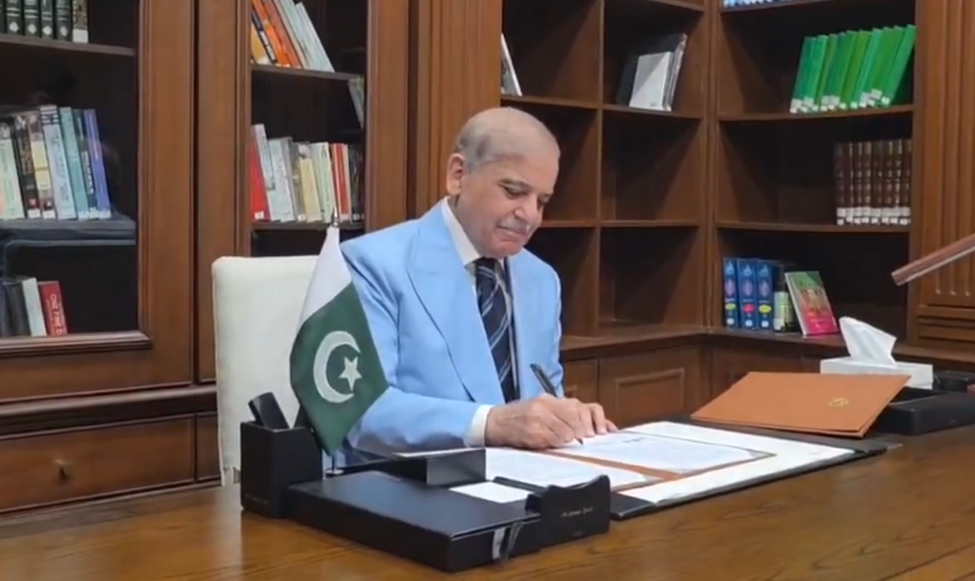
Prime Minister Shehbaz Sharif signs the Islamabad Memorandum of Understanding, 18 June 2026 (image via X/Twitter @PakPMO)
* * * * *
By the time the Islamabad Memorandum was signed on 17 June, Pakistan had converted a fragile, improvised role into the principal organizing channel for consequential U.S.-Iran diplomacy. It had not fully resolved the disputes at the heart of the war, nor had not built a reliable channel to the IRGC. But, working alongside Qatar’s shuttle diplomacy and Egyptian support, Islamabad had done what no single actor had managed since the collapse of diplomatic relations between Washing and Tehran: gotten both capitals to sign the same document.
Even following the collapse of the MOU, Pezeshkian has called for a return to the agreement, noting that it was “the product of the collective wisdom of the members of the Supreme National Security Council” and “will become the cornerstone of our foreign policy in the years ahead.” Now, Pakistan’s Field Marshal Munir is reprising the role as an intermediary. His 24 August visit to Tehran renewed contacts with senior Iranian officials including President Masoud Pezeshkian, Parliamentary Speaker Mohammad Bagher Ghalibaf, and Supreme National Security Council Secretary Mohsen Rezaei, and resulted in those officials conveying conditions for renewed diplomacy with Washington. While the final outcome of the war is not yet determined, Islamabad is seeking to maximize the value and overcome the limits illustrated in its mediation efforts thus far.
Salman Asghar is an independent researcher with a Bachelor's degree in Mechatronics Engineering from National University of Sciences and Technology (NUST), Pakistan, and Master's degree in International Relations and Security Studies from Air University, Pakistan. His research interests lie in the fields of global security dynamics, diplomatic negotiations, and emerging technologies. With an engineering background and expertise in International Relations, he brings a multidisciplinary perspective to contemporary security issues.


