


The U.S.-Ukraine 20-point peace proposal, explained
- Michael MacArthur Bosack

- Dec 25, 2025
- 8 min read

Ukrainian Lead Negotiator Rustem Umerov and his team engage with U.S. Secretary of State Marco Rubio, Special Envoy Steve Witkoff, and Jared Kushner in Miami, 30 November 2025 (photo via Telegram/Rustem Umerov)
On 24 December, President Volodymyr Zelensky sat down with journalists and walked them through the 20-point peace proposal that U.S. and Ukrainian negotiators had developed for engagement with Russia. Whittled down from the U.S. government’s original 28-point proposal revealed in November, this new document is the outcome of three weeks of negotiations led by Steve Witkoff for the U.S. side and Rustem Umerov for the Ukraine side.
The 20-point proposal salvages as many core interests for Ukraine as possible despite the original document being anchored in the Kremlin’s maximalist demands. It eliminates several extraneous issues specific to U.S.-Russia interests and focuses negotiations with Russia on provisions necessary to ensure a durable peace process. There are still unresolved issues between Washington and Kyiv that the two sides are seeking to resolve before the new year. However, even if they do, they will likely be met by a Kremlin that holds firm with the expectation that the Donald Trump administration pressures Ukraine to accept additional compromises.
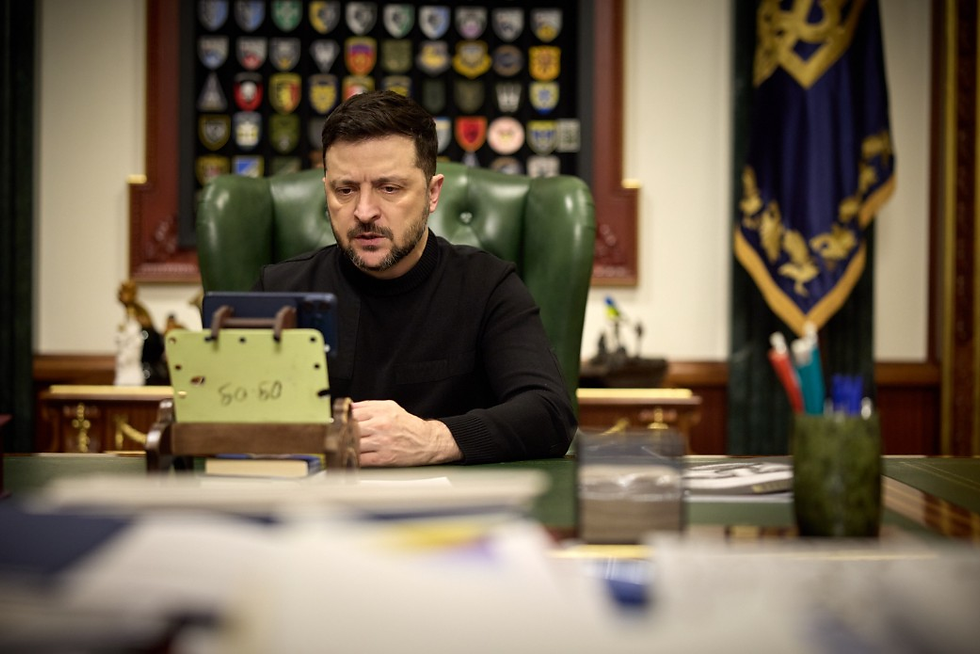
President Volodymyr Zelensky conducts his nightly address, 23 December 2024 (photo via Ukraine’s Presidential Office)
Negotiating a 28-point anchor to a 20-point proposal
This stage of negotiations substantively began in late October when Russian Special Envoy Kirill Dmitriev traveled to Miami for secret meetings with U.S. Special Envoy for Peace Missions Steve Witkoff. The two deliberated the peace process for Russia and Ukraine with no substantive readouts or statements. A month later, details of a U.S.-produced 28-point peace proposal broke in the media.
The proposal immediately drew condemnation for resembling a wish list for Russia’s maximalist demands, prompting questions as to who actually drafted the document. On 23 November, U.S. Secretary of State Marco Rubio confirmed that it was indeed the U.S. government who developed the proposal, noting that it was meant to be a “strong framework for ongoing negotiations.” While in Bishkek, Vladimir Putin confirmed during a press conference that the 28-point proposal was the product of deliberations between the United States and Russia.
Using the 28-point proposal as the anchor for their discussions, U.S. and Ukrainian negotiators continued their deliberations. From 30 November to 1 December, the two sides met in Miami to discuss the proposal ahead of Steve Witkoff’s planned trip to Moscow. The two sides did not disclose changes to the proposal, though there were some indications that the number of points dropped down to somewhere between 19 and 22.
On 2 December, Steve Witkoff met with Vladimir Putin to continue U.S.-Russia discussions. The meeting lasted approximately five hours, and afterwards, Kremlin aide Yury Ushakov stated that there were no negotiations over specifics; rather, they discussed the broad content of the peace plan. Ushakov added that there was no agreement on the U.S.-Ukraine compromise proposal given that there were still unacceptable provisions for the Russia side.

Steve Witkoff and Jared Kushner meet with Vladimir Putin, Yury Ushakov, and Kirill Dmitriev in Moscow, 2 December 2025 (photo via the Kremlin)
On 10 December, Zelensky discussed the issue of the ongoing peace negotiations in his nightly address. He clarified that there were now three core areas of negotiation going forward: the peace agreement, an agreement on security guarantees, and an agreement on postwar reconstruction. He also revealed that the number of points in the peace proposal had become twenty.
A few days later on 15 December, U.S. and Ukrainian negotiators met again–this time in Berlin. They continued their deliberations on the three main lines of negotiations, and the Kremlin’s demand for Ukrainian forces to withdraw from the Donbas region remained a major sticking point in the talks. At the same time, Zelensky and Ukrainian negotiators met with European counterparts who issued a supplemental 6-point framework for peace:
Sustained and significant support to Ukraine’s armed forces to remain at a peacetime level of 800,000 troops
A European-led “Multinational Force Ukraine” as part of the Coalition of the Willing” to support regeneration of Ukraine’s forces and to help protect Ukraine’s air and maritime areas
A U.S.-led ceasefire monitoring and verification mechanism
A legally binding defense commitment against future armed aggression
Investment in postwar reconstruction
Support to Ukraine’s accession to the EU

Volodymyr Zelensky joins U.S. and European counterparts for a photo on the sidelines of peace-related negotiations, 15 December 2025 (photo via X/Twitter @ZelenskyyUa)
This framework would inform follow-on U.S.-Ukraine negotiations, the next round of which occurred from 19-21 December in Miami. This time, they invited European counterparts to the discussions, adding multilateral security guarantees to the other three issue areas–peace agreement, bilateral security guarantees, and postwar reconstruction–that they covered in their deliberations.
There were no substantive readouts from these negotiations, but they notably bookended the next round of talks between U.S. negotiators and Russian Special Envoy Dmitriev. The U.S.-Russia talks took place from 20-21 December in Miami, with Kremlin Spokesperson Dmitry Peskov noting that Dmitriev was present to collect information. Yury Ushakov separately told reporters that the Russia side’s intent was to “stick to what we agreed on in Anchorage and at other meetings with American representatives.”
The changes from 28 to 20 points
The original U.S. proposal was derived heavily from Russia’s maximalist demands, which the Ukraine side sought to bring closer to center through the last three weeks of negotiations. While the original 28-point proposal included many U.S.-Russia-specific interests, the 20-point proposal is more grounded in the core issues within the Russia-Ukraine War. The changes are detailed below.
- Amended: Ukrainian troop cap increased to 800,000
The Russia side has consistently demanded restrictions on the size of Ukraine’s standing forces. The original U.S. 28-point proposal capped troop numbers at 600,000, but the new proposal raises that figure to 800,000.
- Removed: Provision related to Russia-NATO dialogue
This was an out-of-place provision calling for Russia-NATO dialogue that only complicated the negotiating process while inadvertently advancing Russia's claim that the full-scale invasion in February 2022 was triggered by NATO expansion. The U.S. and Ukraine sides have now omitted this provision.
- Removed: Prohibition related to potential NATO accession for Ukraine
Inclusion of this provision was a non-starter for Ukraine, but its removal does not mean NATO accession will happen. Accession requires unanimous consent among all NATO members, and while Hungary’s Viktor Orban has already said he would not support it, the U.S. could make a backdoor agreement with Russia that this will not happen.
- Removed: Prohibition of NATO troops in Ukraine
This will continue to be a point of contention for the Kremlin who opposes any deployment of foreign troops in Ukraine. However, a blanket ban would create problems for monitoring mechanisms and defense commitments, which is why this provision was likely removed.
- Removed: Provision related to deployment of European jets in Poland
This was likely folded into defense commitments and the separate agreement on multilateral security guarantees for Ukraine.
- Removed: Reintegration of Russia into the global economy
While there is no longer a specific mention of this issue, the 20-point proposal still provides for the U.S. to pursue a bilateral free trade agreement with Russia. This would essentially satisfy this point in a different way.
- Removed: Using seized Russian assets for postwar recovery
The 28-point proposal specifically referenced seized Russian assets, but the new proposal removes this explicit mention. They have likely removed it owing to Kremlin opposition, but they retained a point about establishing recovery funds for Ukraine which means the use of seized assets could still be on the table if Russia balks at negotiations.
- Removed: Provision related to the resumption of U.S.-Russia START negotiations
The 28-point proposal included a provision related to U.S.-Russia arms control which was out of place in a Russia-Ukraine ceasefire agreement. The 20-point proposal omits this.
- Amended: No more proposed IAEA involvement in Zaporizhzhia Nuclear Power Plant (ZNPP) management
The International Atomic Energy Agency currently has a team present at ZNPP to mitigate nuclear disaster. Ukraine apparently has concerns that leaving ZNPP under IAEA control will leave the plant in a status quo condition.
- Amended: No mention of Nazism in education provisions
The Russian position is that there must be legislation and educational reform to eradicate nazi ideology in Ukraine. The Kremlin is firm on this proposal because it is one of the core justifications for the "special military operation,” while Ukraine does not want to include any provision that may appear to validate this false claim used to justify Russian aggression.
- Amended: No specific timeline for an election in Ukraine
The Russian position is for Ukraine to hold a presidential election within 100 days of lifting of martial law. The Zelensky administration is already preparing for an election, so this will not be a sticking point. However, Kyiv is exploring the option of putting a peace agreement to a public referendum which may be a point of contention for the Russian side.
- Removed: Amnesty clause for crimes committed during the war
The Kremlin wants withdrawal of international legal action against Russia as part of the peace agreement, which the U.S. included in its 28-point proposal. The 20-point proposal removes this provision, but it will likely meet objections from the Kremlin.
What comes next?
Since revealing the contents of the 20-point proposal, both Zelensky and Umerov have engaged Steve Witkoff via phone to discuss next steps. Zelensky announced that additional work is forthcoming at the highest levels. The Kyiv Post reported that Ukrainian officials are working on securing a meeting between Zelensky and U.S. President Donald Trump at Trump’s Florida resort of Mar-a-Lago. This could happen as early as 28 December, and the objective is to work through the final sticking points in the negotiation.
While the U.S. and Ukraine struggle to gain final consensus, the Kremlin has not yet weighed in, nor are they likely to do so. Up to this point, Russia has not had to make any significant concessions, and there is no real reason for them to concede anything now. The likeliest approach from the Russia side will be to cling to maximalist demands and rely upon the U.S. government to push the Ukraine side to accept additional compromises to advance the peace process.
When the negotiations do happen between the United States and Russia, the Kremlin is likely to push the following positions based on the 20-point proposal:
Withdrawal of Ukrainian forces from Donetsk
Inclusion of some language related to non-NATO accession and anti-Nazism in Ukraine (even if it is just in the form of pledges rather than concrete provisions)
Status quo management of Zaporizhzhia Nuclear Power Plant
No NATO forces in Ukraine (although unarmed third party observers may be acceptable)
Amnesty for Russia against international legal action
To note, Russia will likely push back on the change to troop limits because it benefits them to do so in the negotiation, but they will likely treat it as a disposable interest for logrolling at the table. In other words, they will say, "We will accept an increased number of troops, but you must accept [x], [y], and [z] in exchange.”
Ultimately, the shift from a 28-point anchor to a 20-point proposal reflects Kyiv’s effort to salvage core interests within a negotiation space initially constrained by the Trump administration’s reticence towards challenging the Kremlin’s maximalist demands. Yet the structural imbalance remains: Russia has conceded little, and its negotiating posture suggests it will continue to trade easily reversible concessions for permanent political and territorial gains. The coming phase will test not only Ukraine’s red lines, but whether Washington is prepared to resist becoming the primary lever through which Kremlin pressure is applied.
Michael MacArthur Bosack is a seasoned international negotiator and the founder of the Parley Policy Initiative. He is the Special Adviser for Government Relations at the Yokosuka Council on Asia-Pacific Studies. Michael is a former East-West Center Fellow, a military veteran, and the author of “Negotiate: A Primer for Practitioners.”
U.S. 28-point peace proposal:
U.S.-Ukraine 20-point peace proposal:


