


Lessons from the Concert of Europe for managing dual contingencies in Northeast Asia


The Congress of Vienna, engraving by Jean Godefroy after Jean-Baptiste Isabey,1815 (photo via Wikimedia Commons)
The strategic environment of Northeast Asia is becoming more volatile. As the chances of a dual contingency—China embarking upon a full-blown invasion of Taiwan and North Korean military provocations in the Korean Peninsula—is increasing, a new dimension of instability is being introduced into the regional order. If such contingencies were to occur, the United States and its allies would face daunting challenges in managing simultaneous crises across two operational theaters that are geographically separated yet strategically interconnected. Structural conditions further complicate the problem. China’s expanding conventional military capability coupled with North Korea’s advancing nuclear and missile arsenal is narrowing the strategic maneuvering room for Washington, Tokyo, and Seoul.
Under circumstances where the structural balance of power is tightening and the risk of escalation is increasing, history offers useful insights. More specifically, the European order that emerged after the 1815 Congress of Vienna provides a conceptual framework that could manage instability in a geopolitically contested environment. Although the historical context widely differs, the crisis management principles and balance-of-power diplomacy implemented by figures including Klemens von Metternich, Robert Stewart (Viscount Castlereagh), and Charles-Maurice de Talleyrand offers meaningful lessons for modern Northeast Asian crisis management.
The Logic of Post-Vienna Diplomacy
The Concert of Europe was not a mere balance-of-power system; rather, it was an acknowledgment that strategic competition and miscalculation can contribute to warfare, but that this conflict can be mitigated by structured engagement. Thus, it was a diplomatic framework specifically designed to prevent large-scale war between great powers. After decades of revolutionary tumult and the Napoleonic Wars, European statesmen acknowledged that a rigid alliance system alone would be insufficient to maintain stability. As a result, they structured a framework that enabled great powers to communicate, negotiate, and collectively manage emerging crises.
This system was not merely theoretical. It operated through a series of diplomatic conferences, including the Congress of Aix-la-Chapelle (1818), the Congress of Verona (1822), the London Conference (1830), the London Straits Convention (1841), and later great-power conferences such as the Congress of Paris (1856), the Congress of Berlin (1878), and a number of other forms of ambassadorial diplomacy. Through these conferences, the European powers discussed emerging disputes while coordinating countermeasures against revisionist and subversive actors. Such consultation allowed the leaders to resolve problems before they escalated into systematic military conflict. Although there were a number of hiccups that undermined the Concert of Europe—most notably the revolutions in 1830 and 1848, and the Crimean War in 1853-56—the Concert more or less ensured regional stability until 1914 when the lessons and mechanisms from Vienna lost out to the rising nationalist and militarist tensions that ignited World War I.
Austria’s Metternich, Britain’s Castlereagh, and France’s Talleyrand played critical roles in shaping this order. Despite representing countries with divergent national interests, these individuals shared the perception that stability necessitated active diplomatic engagement and restraint. The key objective in the post-Vienna era was to manage—and not necessarily eliminate—great power rivalry within a framework that could preserve the overall systemic equilibrium.
There were three notable characteristics of post-Vienna diplomacy. First, great powers pursued uninterrupted consultations through congresses and exchanges of diplomatic correspondence. Second, European leaders actively attempted to prevent crises from escalating into a systemic war by addressing grievances before they hardened into irreconcilable conflict. Third, this system heavily relied on individual diplomacy that could strike a balance between national interests and broader systemic stability.
Structural Constraints in Northeast Asia
To be sure, Northeast Asia presents a different geopolitical environment—above all, contemporary Northeast Asia is operating under the specter of nuclear war. Nonetheless it shares certain commonalities with early 19th century Europe; for instance, there exist a number of powerful countries with divergent security interests in both regions that are subject to bloc politics.
China’s military modernization has substantially altered the regional power balance. The expansion of its naval and missile forces as part of its anti-access and area denial (A2AD) strategy has notably increased China’s capacity to conduct military operations in the Western Pacific. At the same time, North Korea’s development of nuclear weapons and long-range missiles has introduced additional strategic unpredictability. Pyongyang’s ability not only to strike South Korea and Japan, but also the U.S. mainland is complicating the allies’ deterrence structure. These unprecedented capabilities are creating room for countries like North Korea to attempt nuclear decoupling between the United States and the two democracies in Northeast Asia, challenging the decades-old concept of extended deterrence that the United States offered to its regional allies.
Under such circumstances, the United States, Japan, and South Korea must maneuver within increasingly narrow strategic margins. While a direct collision would accompany the risks of rapid escalation, excessive restraint could, on the contrary, embolden opportunistic activities by China or North Korea. For instance, Beijing could interpret a massive U.S. troop relocation to Europe as a golden opportunity to increase pressure around Taiwan or the East China Sea. Meanwhile, Pyongyang could use controlled military escalation to test U.S.-ROK alliance cohesion. Simply put, the three democracies in this region are now obliged to assume the Herculean task of mitigating crises while preventing spoilers from exploiting fissures in the regional order.
Managing such a delicate balance requires a combination of deterrence and diplomacy; precisely the challenge that European statesmen faced after 1815.

Vladimir Putin speaks with Xi Jinping and Kim Jong Un at Beijing’s Victory Day parade, 3 September 2025 (photo via the Kremlin)
Lessons from the Concert of Europe
The first lesson that could be extracted from post-Vienna diplomacy is the importance of sustained great power dialogue. Metternich and Castlereagh fully understood that misperception and distrust were key factors in conflict. Regular communication among great powers lowered the probability that crises would spiral out of control, because it mitigated misperception and created structured diplomatic channels for crisis management.
In Northeast Asia, similar mechanisms for continuous conversation remain underdeveloped. Although diplomatic channels between the U.S. and China exist—including the Maritime Military Consultative Agreement—and China maintains a military hotline with Japan, these mechanisms are often underutilized and activated only during crises. The experience of post-Vienna diplomacy illustrates that communication channels work most effectively when they are routine rather than episodic. During most of the 19th century, great powers maintained regular diplomatic consultations and convened multilateral conferences during moments of tension, thereby creating predictable pathways for crisis management. Applying a similar logic to today’s world would necessitate institutionalizing regular strategic dialogue, expanding military-to-military communication mechanisms, and establishing a multilateral crisis consultation framework among the United States, Japan, and South Korea in an era of heightened tension.

Military representatives from U.S. Indo-Pacific Command, U.S. Pacific Fleet and U.S. Pacific Air Forces meet with China’s military representatives for the Military Maritime Consultative Agreement Working Group in Honolulu, 3 April 2024 (photo via U.S. Department of Defense / Petty Officer 1st Class Randi Brown)
The second lesson concerns the role of middle powers in maintaining regional stability. During the Congress of Vienna, Talleyrand enabled a vanquished France to remain integrated within the European diplomatic system through diplomatic maneuvering. This particular measure successfully prevented the emergence of a revisionist power that intended to reshuffle the regional order through a new conflict. The broader lesson is that diplomatic inclusion and active engagement by secondary powers can help stabilize great-power relations by preventing the emergence of dissatisfied actors outside the system.
In Northeast Asia, Japan and South Korea could play a similar stabilizing role. The two countries could contribute to constructing a diplomatic framework—one that goes beyond their role of merely functioning as U.S. military allies in the region—that emphasizes crisis management and communication. For instance, Japan and South Korea could coordinate diplomatic initiatives aimed at maintaining communication channels with Beijing when tension increases; this requires a resilient Japan-South Korea relationship that is less vulnerable to occasional political events that stir up domestic sentiments in the respective countries. In that extent, leaders of both countries need to consistently educate the public on how structurally heightened risk—originating from China, North Korea, and Russia—in Northeast Asia leaves smaller room for Japan-South Korea disputes.
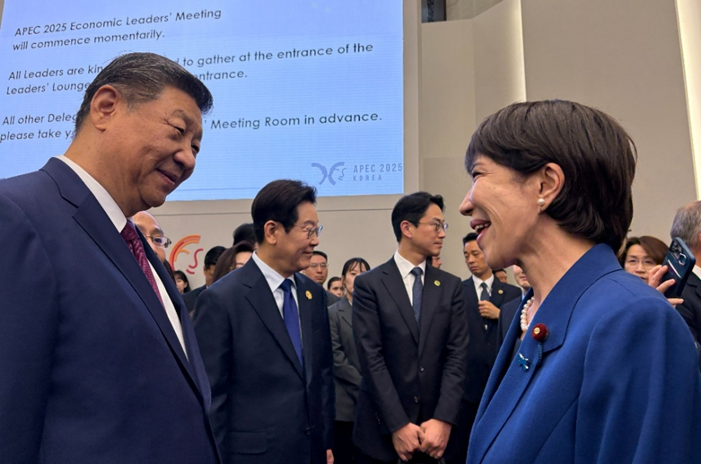
Japanese Prime Minister Sanae Takaichi speaks with Chinese President Xi Jinping near South Korean President Lee Jae Myung at the APEC summit in Gyeongju, October 2025 (photo via X/Twitter @takaichi_sanae)
The third lesson involves the importance of strategic restraint. The architects of the Concert of Europe recognized that no single power alone could achieve absolute security. Instead, stability required some degree of mutual accommodation. This principle means that deterrence and diplomatic engagement should be combined in order to prevent the worst-case outcome, rather than renouncing deterrence.
For the United States and its regional allies, this could refer to avoiding policies that unnecessarily accelerate the security dilemma while preserving credible deterrence. At the same time, China and North Korea should also understand that any aggressive attempt to exploit a window of opportunity—for example, simultaneous coercive pressure during a Taiwan contingency—could destabilize the regional order and inevitably trigger counterbalancing coalitions, while recognizing that accommodation does not equal accepting a sphere of influence in the region.
Personal Diplomacy in an Age of Structural Constraint
The most enduring lesson of post-Vienna diplomacy is probably the role of personal political leadership. Metternich, Castlereagh, and Talleyrand maneuvered within structural constraints similar to those faced by contemporary decision-makers. Nonetheless, their diplomatic skills enabled decades-long systemic stability by managing competition.
Although modern diplomacy often heavily depends upon institutional procedures, the importance of leadership should not be underestimated. Effective crisis management necessitates diplomats and political leaders who can grasp the common interest, namely stability, amid strategic rivalry. To be sure, it would be a tall order to expect Trump and Xi to share a common mindset as the three statesmen that convened at the Congress of Europe. Nevertheless, it would be imperative for U.S. and Chinese leaders to recognize that disrupting the current regional order in Northeast Asia would not necessarily guarantee the emergence of a more stable order. This could be pursued through sustained strategic dialogue and crisis-management mechanisms that clarify red lines and reduce miscalculations, since without such efforts strategic rivalry could escalate into a destabilizing security dilemma.
Conclusion
As mentioned, the geopolitical reality of today’s Northeast Asia is widely different from that of 19th-century Europe. Combination of a series of elements including nuclear weapons, technological rivalry, and ideological polarization have created a far more complex and challenging strategic environment. Nevertheless, the crucial insights of the post-Vienna order remain valid. In a highly competitive multipolar system, stability depends not on military strength alone, but also on proactive diplomatic engagement.
While the strategic maneuver space for the United States, Japan, and South Korea is incrementally narrowing, it is imperative to establish a diplomatic framework, a Northeast Asian equivalent of the Concert of Europe, that could manage rivalry without allowing it to escalate into regional conflagration.
The statesmen of the Concert of Europe understood that peace and stability cannot be ensured by military power alone. Their experience illustrates that diplomacy based on communication, restraint, and practical leadership remains an essential ingredient in maintaining stability that transcends time and place.
Dr. Ju Hyung Kim currently serves as a President at the Security Management Institute, a defense think tank affiliated with the South Korean National Assembly. He has been involved in numerous defense projects and has provided consultation to several key organizations, including the Republic of Korea Joint Chiefs of Staff, the Defense Acquisition Program Administration, the Ministry of National Defense, the Korea Institute for Defense Analysis, the Agency for Defense Development, and the Korea Research Institute for Defense Technology Planning and Advancement. He holds a doctoral degree in international relations from the National Graduate Institute for Policy Studies (GRIPS) in Japan, a master’s degree in conflict management from the Johns Hopkins University School of Advanced International Studies (SAIS), and a degree in public policy from Seoul National University’s Graduate School of Public Administration (GSPA).


