


Averting crisis and conflict in Bougainville

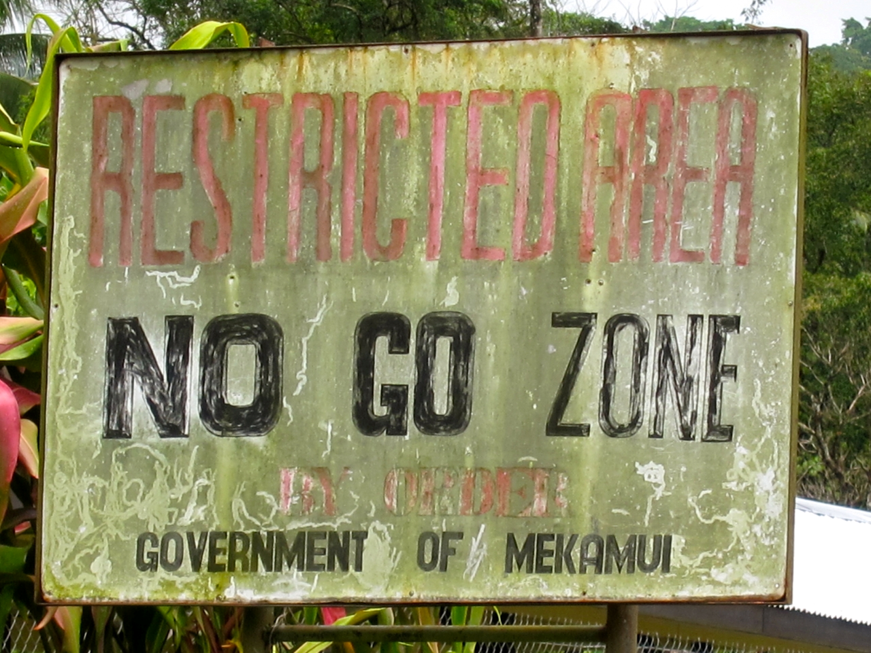
A restricted area sign placed outside of the controversial Panguna mining complex (photo via Flickr user Madlemurs)
Bougainville is slated to become the world’s newest independent country by 2027, but the outcomes of this independence process could become a source of crisis rather than celebration.
On 2 June, Chairman of the Parliamentary Bipartisan Committee on Bougainville Matters, Dr. Allan Marat, presented an interim report to the Papua New Guinea (PNG) parliament—a key step before legislators vote on whether to ratify Bougainville’s independence referendum. The island community already exists as an autonomous region under existing legal frameworks with the PNG government, but this vote would advance the process of permanently separating Bougainville from PNG as part of an arrangement borne from a long and bloody civil war.
While the parliamentary report identifies important concerns regarding Bougainville’s path to independence, it stops short of assessing the specific scenarios most likely to trigger crisis or conflict. There are four risks that could contribute to escalation: the PNG legislature rejecting or indefinitely delaying ratification of Bougainville’s independence referendum; malign third party influence; catastrophic failures in government services to Bougainville; and internal Bougainvillean divisions. Measures must be put in place to avert political aggravation of tenuous conditions, reinforce the involvement of third parties who support durable peace between Bougainville and PNG, mitigate disruption of essential services, and strengthen internal cohesion during a potentially contentious transition period.
Bougainville’s fate carries implications beyond the island itself. The outcome will influence the credibility of negotiated self-determination processes in the Indo-Pacific and may shape how other autonomy movements view peaceful pathways to political change.
Background on the civil war and peace process
Tensions between Bougainville and external authorities extend back to when PNG fell under Australian administration. The island remained under the purview of its much larger neighbor from 1914 to 1975, interrupted only by Japanese occupation from 1942 to 1945. It was during the post-World War II period that Bougainville emerged as an attractive site for gold and copper mining. Australian-linked companies initiated mining operations in Bougainville in the late 1960s, centered on the main Panguna mine. This contributed to tensions between Bougainville residents and the PNG government as the rate of returns for the local community did not keep pace with the amount of value being produced from the mining activities.
By the 1980s, grievances mounted over environmental degradation, inequitable distribution of mining revenues, and perceptions of political marginalization, and crisis erupted between Bougainvillean groups and the PNG government. The unrest led to violence and a decade-long civil war that resulted in an estimated 15,000 to 20,000 deaths—many resulting from the blockade of the island and the disruption of food imports, medical supplies, and life-support services.
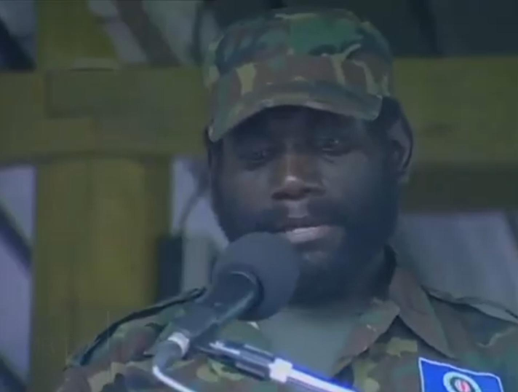
Then-Commander of the Bougainville Revolutionary Army Ishmael Toroama delivers a speech at the signing of the Bougainville Peace Agreement, 30 August 2001 (Photo via YouTube @Bougainvillean)
The eventual peace process culminated in the Bougainville Peace Agreement of 2001. This comprehensive, 74-page agreement established a framework for autonomy and called for a future referendum on independence. It also provided for the creation of the Autonomous Bougainville Government (ABG) which would oversee administration of the island and serve as the official counterpart with the PNG government.
Elections were held for the first ABG in 2005, and the independence referendum took place within the fifteen year time limit following the government’s formation. The December 2019 referendum presented a choice between greater autonomy within PNG and full independence. It resulted in an overwhelming vote of 97.7% in favor of independence.

A Bougainvillean resident presents her inked finger after voting in the 2019 referendum (photo via X/Twitter @BRC2019)
The role of third parties in Bougainville
Third parties have played both stabilizing and destabilizing roles in Bougainville. Throughout the Bougainville conflict and subsequent peace process, governments, international organizations, and private companies have all influenced the course of events, sometimes supporting reconciliation and at other times contributing to friction points between residents and government authorities.
One of the most constructive roles played by third parties has come through peacekeeping and mediation efforts. Regional governments, particularly Australia, New Zealand, Fiji, and Vanuatu, supported negotiations that culminated in the 2001 peace agreement. A multinational Peace Monitoring Group helped build trust between former combatants by monitoring ceasefires, facilitating communication, and providing a neutral presence on the ground. Their involvement reduced the risk of renewed violence and gave communities confidence that commitments made during negotiations would be respected.
External aid and international support have also been important contributors to long-term peacebuilding. Donor governments, development agencies, and international organizations provided funding for reconstruction, healthcare, education, and governance programs. These initiatives helped restore essential services and strengthen local institutions, creating conditions that supported reconciliation and stability.
However, some third parties have played a problematic role through the pursuit of economic gain. Commercial interest in Bougainville’s natural resources has at times outpaced concern for local communities, and the operations of foreign-owned mining interests have become a major source of grievance both before and during the conflict. Many Bougainvilleans observed profits flowing to external companies and governments while local communities bore the environmental damage and social disruption. The perception that economic interests were prioritized over local concerns contributed to tensions that eventually escalated into violence. Problems surrounding the Panguna mine have never been fully resolved.
Even after the peace process began, concerns remained that outside commercial actors could undermine stability if resource extraction were pursued without broad community consent. Recent competition for access to minerals has played out between Indian and Chinese companies, with the India-based Lloyds Metals and Energy Limited winning the competition. However, political instability could create opportunities for external commercial actors to seek revisions to existing resource agreements. Any deterioration in relations between the PNG government and the ABG could create opportunities for these foreign entities to advance commercial interests in ways that complicate negotiations or undermine public confidence in the transition process.

ABG President Ishmael Toroama shakes hands with Balasubramanian Prabhakaran of Lloyds Metals and Energy Limited upon signing a Memorandum of Understanding for re-development of the Panguna Mine, 20 November 2025 (photo via the Autonomous Bougainville Government)
The post-referendum environment
Following the referendum, the ABG and PNG government entered negotiations on the way ahead for fulfilling the vote’s outcomes. In July 2021, the two sides reached an agreement in which Bougainville would gain independence by 2027 pending ratification by the PNG parliament.
In preparation for the vote, the PNG parliament commissioned the 2026 report of the Bipartisan Parliamentary Committee on Bougainville matters presented in early June. Using mixed methodologies of surveys among the Bougainville population and qualitative analysis of various factors affecting the independence process, the report focused on five principal issues:
Readiness. The report questioned whether Bougainville would truly be ready to separate from PNG by 2027 and exercise self-governance.
Reconciliation. It identified that while progress had been made in peacebuilding, additional reconciliation efforts would be necessary, especially if the PNG parliament decided to vote against or delay ratification of the independence referendum.
Sequencing. The report highlighted potential challenges in sequencing of independence implementation. It noted that a deliberate process would be necessary to mitigate unintended consequences.
Responsibility. The report identified that there are lingering questions over the actual constitutional role of the PNG parliament in Bougainville’s independence process; namely, as a facilitator for implementation or a decider for its fate.
Precedent. It indicated that Bougainville’s secession could create a template for other autonomy or independence movements within PNG.
Of the five issue areas, the question of responsibility has become increasingly significant. The ambiguity in the PNG parliament’s post-referendum role became more consequential following the adoption of a parliamentary sessional order on 9 June 2026 establishing procedures for the ratification vote. The order requires a three-quarter majority—84 of the parliament's 111 members—for ratification. This threshold exceeds previous proposals ranging from a simple majority to a two-thirds majority and raises questions regarding whether parliament possesses authority to establish such a requirement through a sessional order when neither the Bougainville Peace Agreement nor relevant constitutional provisions explicitly prescribe a voting margin.
The procedural pathway now consists of parliamentary debate, a ratification vote, and potentially further negotiations through a joint supervisory body should implementation be delayed or conditioned. While outright ratification or rejection remain possible outcomes, a deferred decision requiring further negotiation may prove the most plausible scenario if sufficient parliamentary support cannot be gathered.
While the committee report was effective in capturing local sentiments and identifying the aforementioned issues, what the committee did not do was identify specific friction points or possible triggers for renewed crisis or conflict. Consequently, the report could not identify measures for mitigating these potential problems.
Following the presentation of the report, the PNG parliament decided that it would carry out the ratification vote on 30 August, leaving a limited period to prepare for the consequences of any outcomes from the parliamentary decision.

Papua New Guinea Parliament house (photo via Flickr user David Bacon)
Possible contributors to crisis
The critical phase in the independence process is approaching and has introduced new uncertainties. The unresolved political status, combined with economic vulnerabilities and institutional constraints, leaves Bougainville in a delicate position. While the past quarter century has been largely peaceful, the underlying drivers of conflict have not been fully eliminated.
Despite the current stability, several plausible triggers could precipitate acute crisis or renewed conflict in Bougainville.
Risk | Likelihood | Consequence | Mitigation |
Parliamentary rejection | Medium-High | Very High | Mediation; transparency; and phased implementation |
Third party interference | Low-Medium | High | Third party oversight of intragovernmental measures; transparency in economic deals; and implementation monitoring |
Service collapse | Medium | Medium-High | Infrastructure redundancy; establishment of an emergency fund; and fiscal support |
Internal Bougainvillean division | Medium-High | High | Reconciliation, inclusive governance, equitable benefit-sharing, regional consultation |
1. Rejection of independence by the Papua New Guinea legislature.
The most immediate and potentially destabilizing scenario would be rejection of Bougainville’s independence by the PNG parliament. Given the decisive referendum result, such a move could be perceived by Bougainvilleans as a denial of democratic will and a breach of the spirit—if not the letter—of the peace agreement. Rejection could trigger mass protests, harden positions among former combatants, and undermine confidence in negotiated political processes, creating conditions in which isolated violence could escalate.
A less confrontational but potentially more likely scenario would involve parliament deferring ratification and seeking further negotiations. While this approach could reduce immediate political crisis, prolonged delay may generate many of the same frustrations as outright rejection, particularly if Bougainvilleans perceive additional procedural hurdles as mechanisms for indefinitely postponing implementation of the referendum result. Constitutional litigation concerning the ratification threshold or parliamentary authority could further complicate the process and extend uncertainty. Any resulting referral to the Supreme Court could delay implementation timelines while establishing important constitutional precedent regarding the interpretation of the Bougainville Peace Agreement.
2. Destabilizing third party interference.
Given the value of natural resources on the island, external actors may seek to exploit Bougainville’s strategic and political vulnerabilities. Whether through political support, economic inducements, or covert backing of separatist elements, third party influence could exacerbate internal divisions and complicate negotiations between the ABG and PNG government. Such involvement risks exacerbating any tensions that may emerge during the independence process at the expense of the local population.
3. Catastrophic failures in government services.
Bougainville’s infrastructure and public service delivery remain fragile. A major disruption—e.g., a prolonged power outage due to generator failure, or a sudden cessation of financial transfers from the central government—could have cascading effects. Beyond immediate humanitarian and economic consequences, such failures could deepen perceptions of neglect or abandonment by PNG, fueling resentment and undermining confidence in the current governance arrangement.
4. Internal Bougainvillean divisions.
While external political disputes receive the greatest attention, internal divisions within Bougainville may present an equally significant source of instability. In some cases, unresolved wartime grievances overlap with disputes regarding land ownership, resource development, and political representation, creating the potential for localized tensions to escalate during periods of political uncertainty. Differences remain (1) between former Bougainville Revolutionary Army and Resistance constituencies; (2) among communities in the North, Central, and South regions; and (3) between political and economic elites and communities that perceive themselves as excluded from major development decisions.
These divisions have largely remained manageable during the autonomy period. However, they could become more pronounced if the independence process stalls, if expectations are not met, or if major resource projects are perceived to deliver disproportional benefits to a narrow group. In such circumstances, localized disputes could emerge independently of tensions between Bougainville and PNG.

Relief supplies are unloaded from a New Zealand Defence Force C-130 following the eruption of Mt. Bagana, August 2023 (photo via X/Twitter @MFATNZ)
The way ahead
To avert crisis and sustain peace, what is required is a proactive and multi-layered approach that addresses political sensitivities, external risks, and structural vulnerabilities.
Managing political expectations and processes
Constructive engagement between Bougainvillean leaders and the PNG government is essential. Transparent communication regarding the ratification process, timelines, and possible outcomes can help manage expectations and reduce the risk of abrupt political shocks. Confidence-building measures such as mutually agreed, milestone-based steps towards greater independence may offer a middle ground that preserves stability while respecting the results of the referendum. Policymakers should avoid framing ratification as a binary choice between independence and rejection. Instead, independence should be approached as a negotiated process with sequenced implementation milestones that preserve the legitimacy of the referendum outcome while addressing practical governance challenges.
Fostering constructive third party roles
Rather than allowing external actors to act as destabilizing forces, there is an opportunity to channel third party involvement into supportive roles. Regional organizations, development partners, and neutral mediators can continue to contribute to dialogue facilitation, economic development, and institutional strengthening. New Zealand, given its role in the original peace process and reputation as a trusted intermediary, may be particularly well placed to support future dialogue should negotiations become strained. Regional institutions such as the Pacific Islands Forum can also provide venues for constructive engagement and confidence-building.
Carefully structured engagement through existing ombudsmen offices and as third party oversight of implementation of independence measures can provide Bougainville with alternatives that reinforce peace rather than undermine it. This also includes explicit transparency and oversight measures related to economic agreements made between ABG and foreign companies.
Strengthening essential services and economic resilience
Mitigating risks in essential services is critical. Investments in energy infrastructure, transport, and communications can reduce the likelihood of catastrophic failures. Concurrently, establishment of an emergency reserve fund jointly supported by the ABG, PNG government, and international partners and created with the singular purpose of crisis or disaster response will insulate Bougainville from perceived failures of governance. These measures will be especially meaningful if coming from third parties involved in implementation of the Bougainville Peace Agreement and private companies who enter resource agreements with the ABG.
Demonstrating governance readiness will be equally important. As questions regarding Bougainville’s preparedness for independence continue to feature prominently in parliamentary debates, persistent efforts to strengthen accountability institutions, public financial management systems, and anti-corruption mechanisms would help demonstrate governance readiness and institutional maturity. Visible evidence of this progress will assist in building confidence among citizens, development partners, and political stakeholders alike.
At the same time, diversifying Bougainville’s economic base beyond mining and ensuring reliable fiscal transfers will help stabilize governance and reduce dependency-related vulnerabilities. Building local capacity to manage and maintain critical systems should be a priority.
* * * * *
Bougainville stands at a pivotal juncture. The foundations of peace have held for more than two decades, but they are not unshakeable. The convergence of political uncertainty, constitutional ambiguity, external interest, internal divisions, and structural fragility creates conditions in which crisis could emerge if left unaddressed.
The coming parliamentary vote will be consequential, but it is unlikely to represent the end of the process. Whether the outcome is ratification, delay, or renewed negotiation, the durability of peace will ultimately depend on the ability of Bougainvillean leaders, the PNG government, and international partners to manage disagreements without returning to confrontation. By anticipating potential triggers and implementing targeted measures, stakeholders have a narrow but meaningful window to avert conflict and secure a durable, peaceful future for Bougainville.
Frank Filler is a Director of the Parley Policy Institute. Frank has a strong interest in citizen diplomacy and advancing international cooperation, particularly in support of stability and shared prosperity in the Indo-Pacific. His contributions have been recognized through selection as one of the top 150 New Colombo Plan alumni at its 10-year anniversary and through an invitation from the Government of Taiwan to lead a delegation of emerging Indo-Pacific leaders.
Michael MacArthur Bosack is a seasoned international negotiator and the founder of the Parley Policy Initiative. He is the Special Adviser for Government Relations at the Yokosuka Council on Asia-Pacific Studies. Previously, Michael served as the Deputy Secretary of the United Nations Command Military Armistice Commission in Korea and the Deputy Chief of Government Relations at Headquarters, U.S. Forces, Japan. He is a former East-West Center Fellow, a military veteran, and the author of “Negotiate: A Primer for Practitioners.”
Cable No. 63:
Bougainville Peace Agreement of 2001:
Protocol Concerning the Peace Monitoring Group, 1998:


